
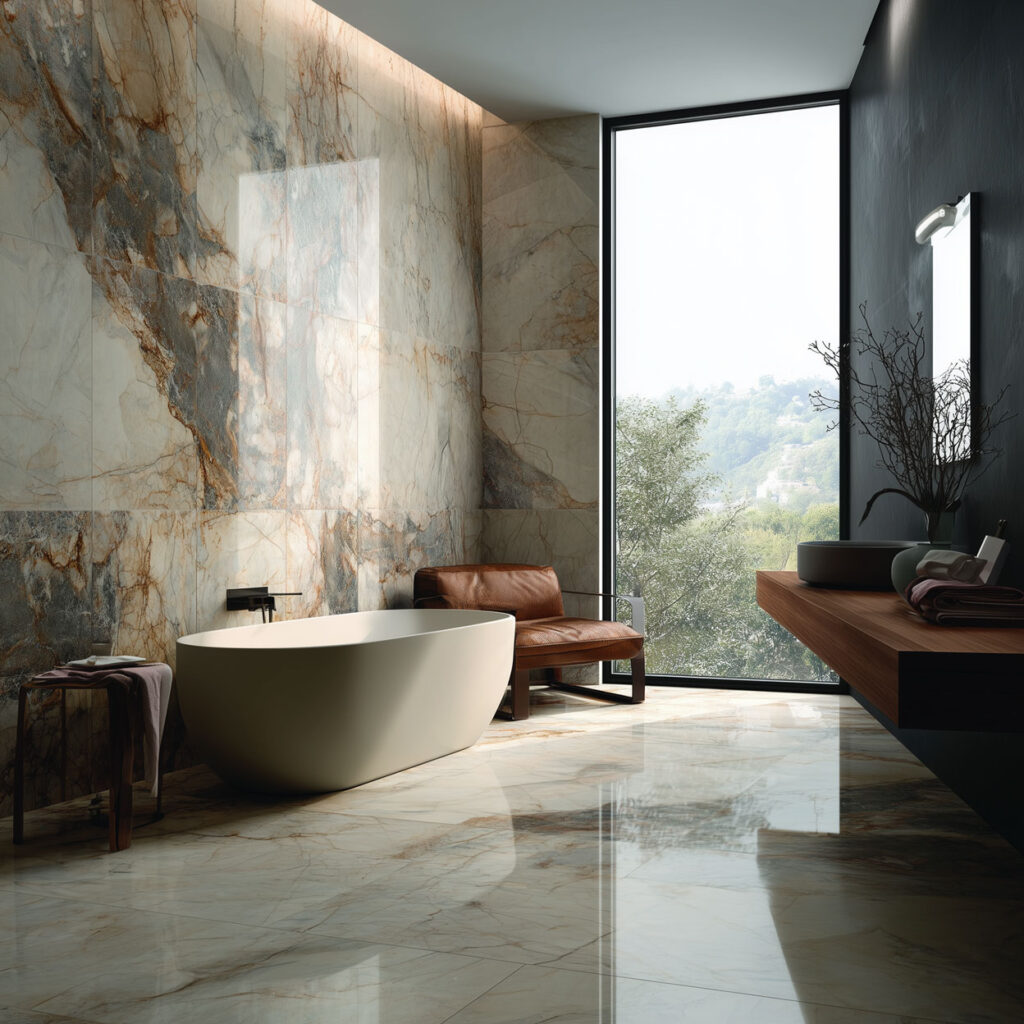
There’s a design “rule” that refuses to die: small room, small tile.
It sounds logical, so people repeat it. But once you see it installed, the rule starts to look… questionable.
Small tiles mean lots of grout lines. And grout lines are basically visual noise. They break up the floor into a busy grid, which can make a tight condo bathroom or narrow Toronto hallway feel even more cramped.
The 2026 move is surprisingly simple. Go bigger.
Large-format porcelain tiles (24×24, 24×48, and beyond) are showing up everywhere in modern interiors, not because they’re trendy, but because they seem to make spaces feel calmer and more open. When done well, the floor starts to read like one continuous surface, and the room instantly feels less “choppy.”
- The Illusion of Space (It’s Mostly About Interruptions)
Your eyes don’t measure a room with a tape measure. They measure it with interruptions.
Every grout line is a stop sign. A lot of stop signs make the room feel broken up. Fewer stop signs make it feel smoother.
That’s why large-format tile can work so well in small spaces. With fewer grout joints, the floor appears to stretch. A powder room feels less boxed in. A condo kitchen feels wider, even if you didn’t move a single wall.
And the “seamless” effect isn’t just marketing talk. On a 24×48 layout, you can get something close to the clean look of polished concrete or slab stone, but with the practicality of porcelain.
Where this tends to make the biggest difference:
- narrow entryways where the grid effect is extra noticeable
- small bathrooms where the eye hits multiple surfaces at once
- condo kitchens where every square foot needs to feel intentional
- Less Grout, Less Annoyance (Yes, It’s a Hygiene Thing Too)
Let’s be honest: grout is the part nobody enjoys maintaining.
Over time, it can darken. It can hold moisture. It can collect whatever your mop missed. Even in “clean” homes, grout has a way of looking tired before the tile does.
Large-format tile reduces grout lines dramatically, and that changes daily life more than people expect. It’s not just about aesthetics. It’s about effort.
With fewer joints, you usually get:
- Easier mopping (less snagging and less buildup)
- Fewer places for dirt to settle
- A cleaner look that stays consistent longer
You might hear claims like “up to 80% less grout,” and depending on tile size and layout, that can be close. The real point is simpler: big tile means fewer seams to scrub. That’s a win in any Toronto condo where you’d rather spend weekends outside than cleaning grout with a toothbrush.
- Color and Pattern Look More Natural on a Bigger Canvas
This part is underrated.
On smaller tiles, patterns can get chopped up. Veining looks interrupted. Concrete-style finishes can start to look “patchy” because the joints break the surface into tiny pieces.
Large-format tile gives the design room to breathe. Veins can flow. Tone stays consistent. The surface looks more like one intentional material choice rather than a collection of small pieces.
Tilecy collections like Zhuan and Roma are designed for that kind of continuity. If you want a concrete-inspired grey for a modern condo, large-format helps it feel smoother and more architectural. If you’re going for a marble look, bigger tile is often what makes it feel believable.
A small note, though: lighting matters. A matte finish can hide shadows and reflections in small spaces. A polished finish can bounce light and brighten the room, but it may also show smudges more easily. Neither is “better,” it just depends on how you live.
Quick Tips Before You Commit (Because Installation Matters)
Large-format tile in small spaces is great, but it’s not a shortcut. A few things still matter:
- Flatness: Big tiles don’t like uneven floors. Prep is everything.
- Layout planning: Starting points, tile direction, and where cuts land can make or break the look.
- Grout color: A close-match grout creates the seamless effect. High-contrast grout makes lines more visible.
- Tile orientation: In narrow spaces, running 24×48 lengthwise can visually “pull” the room open.
This is where working with a good installer pays off. The tile can be perfect, and the result can still look off if layout and prep are rushed.
I’ve seen people do the quiet math in their head. Square footage, waste factor, tax, installation. And suddenly, that “dream tile” turns into “maybe later.”
A lot of the time, the issue isn’t that the tile is magically better. It’s that the tile has already collected costs before it even reaches you.
Why Tile Prices Climb Before You Even See Them
In the traditional tile business, there are usually several stops along the way. A factory produces the tile. Then it moves through an exporter or broker. After that, it may go to a regional distributor, then a local wholesaler, and finally a retailer. Each one adds a margin. That margin might be fair, depending on the services they provide, but it also stacks up quickly.
By the time the tile lands on a shelf in Toronto, you’re often paying for more than the tile itself. You’re paying for the journey.
And to be fair, some middle layers do add value. Warehousing, local inventory, shipping coordination, customer service, returns. Those things matter. But if the chain is long, the costs can start to feel disconnected from the product.
How Tilecy Does It Differently
Tilecy is structured under Importeer Canada, and we try to keep the path simpler. The idea is straightforward: work closer to manufacturing and control more of the flow into our Toronto distribution network.
That approach may suggest a few practical advantages.
For one, pricing can be clearer because there are fewer “invisible” markups. For another, availability often becomes easier to manage, especially for larger projects where matching batches and keeping timelines matters.
Because we manage procurement and distribution more directly, we can reduce or avoid costs that often get baked into retail pricing, such as:
- broker and intermediary fees
- repeated third-party warehousing and handling charges
- stacked distributor and retailer markups
Not every retailer works the same way, and some are genuinely excellent. Still, if you’ve ever wondered why the same style of tile can feel wildly different in price from one place to another, the supply chain is usually part of the explanation.
Consistency Matters More Than People Think
Price gets most of the attention, but consistency is what saves people from headaches.
If you’ve ever been halfway through a renovation and heard “that tile is backordered,” you know what I mean. Or worse, you get a second shipment and the tone is slightly off. It’s not dramatic until it’s installed, and then it’s all you can see.
When a company has tighter control over sourcing and distribution, it’s more likely to keep product details stable and communicate timelines clearly. Not perfect, but more predictable. And in real renovations, predictability is underrated.
Why White-Body Porcelain Is the Standard We Stick With
Now, let’s be honest: “affordable” is only a win if quality stays high.
You can find cheap tile almost anywhere. The question is what you’re actually getting. Big-box stores often carry plenty of red-body ceramic. Some of it is fine for certain uses, but it’s generally softer and more porous than porcelain. That doesn’t automatically make it bad, but it may be more likely to chip in busy areas or show wear sooner, especially in heavy-use spaces like entryways or kitchens.
Tilecy focuses on white-body porcelain because it tends to perform better in the places people actually live in and walk on every day.
What white-body porcelain tends to offer
- Denser structure: It’s fired at higher temperatures, which usually means better hardness and durability.
- Cleaner base tone: The lighter body can help finishes and glazes look sharper and more consistent.
- Cleaner installation look: Many white-body porcelain options come rectified, which makes tighter grout lines possible and gives that modern, more seamless finish people want right now.
If your goal is that crisp, contemporary look, porcelain often gets you closer without needing “special tricks” at installation.
Get In Touch
4789 Yonge Street
Hullmark Corporate Centre
Toronto, Ontario, Canada